
General Architecture and Mechanisms of Elementary Cognition
Our research aims to integrate three conceptual levels of research (theoretical, methodological and empirical) in order to develop veridical mathematical models of cognitive processes.

Our research aims to integrate three conceptual levels of research (theoretical, methodological and empirical) in order to develop veridical mathematical models of cognitive processes.
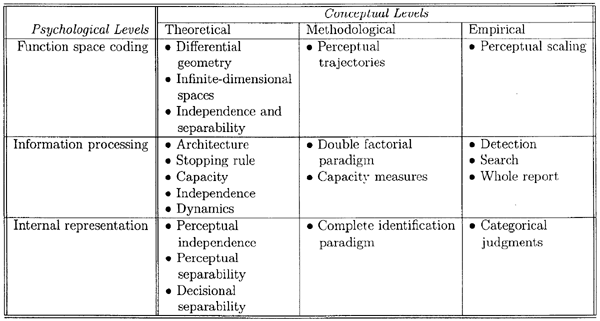
We here encounter the first, and perhaps one of the most challenging, theoretical issues: We need to be able to provide an account, at a suitable level of abstraction, of the perceptual code for this instant in visual time (as discussed in O'Toole, Wenger & Townsend, 2001). Central to the development of such a code are theoretical languages capable of characterizing the numerous shifts in energies across the visual field.
One promising basis for such language can be found in the mathematical discipline of differential geometry. Differential geometry combines classical notions of space, angle, distance, and so on, with the powerful apparatus of the calculus.
It is safe to say it has revolutionized the study of surfaces and much more complex spatial objects, some of which cannot even be pictured in our ordinary kinds of spaces (at least in such spaces of comparable dimensionality). One important branch is that of Riemannian (in honor of Riemann, one of the inventors of non-Euclidean geometry) manifolds (one particular type of space).
A Riemannian manifold looks locally like an ordinary Euclidean space, but can require a way of measuring distance and size that differs greatly from the Euclidean. The earth is a good intuitive example of a Riemannian manifold: locally, we can treat it as flat (i.e., Euclidean), but if we measure the shortest distance between two points we get a great circle, not a Euclidean straight line. Riemannian geometry provided Einstein with the essentials he required for his general theory of relativity and we believe it offers a promising milieu for investigation of potentially quite complex psychological spaces.
A critical accomplishment of the prior period of support was the development of a nascent and rich theoretical language, based on differential geometry, for describing initial 3-D object (e.g., faces) information.
Hypotheses for the processing of this information need to explicitly consider four basic issues about the characteristics of processing (e.g., Townsend & Ashby, 1983; Townsend & Nozawa, 1995):
At the third level of analysis, we can pose questions about cognitive processing in terms of the nature of the psychological representation of the stimulus. Here we are not so much concerned with the nature of the processes that operate on the internal codes as we are with the multidimensional nature of the codes themselves (see discussions of the distinction in Massaro, 1998; O'Toole et al., 2001; Thomas, 1996; Wenger, 1999). Returning to our example of an observer making an affect judgment, imagine that the observer must use the information about both the eyes and mouth to make a judgment that reflects the unique combination of the various states of each of the features (e.g., responding to a smile in the mouth without any discernible happiness in the eyes as being disingenuous).
This is a situation that corresponds to a prototypical experimental design known as a complete identification task, and is one that has been of critical importance for a developing the multidimensional generalization of signal detection theory known as general recognition theory (GRT, Ashby & Townsend, 1986; Thomas, 1995, 1996; Townsend, Hu & Evans, 1984). GRT provides rigorous, consistent definitions for a set of constructs pertaining to aspects of representation that, prior to GRT, had been subsumed under terms associated with the notion of configurality, such as integrality (e.g., Garner, 1974j Maddox, 1992). GRT makes distinctions between perceptual and decisional sources of configurality, and between configurality that can exist within the information for a single stimulus and configurality that exists in the effects due to variations across stimuli. For example, configurality at the level of a single stimulus could be due to a violation of perceptual independence (PI, as it is rigorously defined in GRT). In this type of configurality failure, two parts of a figure (e.g., features or dimensions) would interact, in the sense that the accuracy on one depends probabilistically on the accuracy on the other-within a specified stimulus.
Configurality failure could also be due to the presence of perceptual separability (PS) (in Garner's (1974) terms, non-integrality), something that would be evident across variations in stimuli rather than within a single stimulus. Thus, as mentioned earlier, the setting on one dimension (e.g., a smiling vs. neutral mouth) would affect the general perception of another dimension (e.g., the perceived average length of a red rectangle).
Finally, a "weak" form of configurality could be obtained by systematic shifts in an observer's decisional criteria across variations in stimuli, referred to as a violation of decisional separability (DS).